
Scenario I: Energy / Water
The development and usage of AI is rapidly accelerating, placing increasing demand on our world’s natural resources. This is particularly salient in areas where data centres are located, with energy and water resources already showing visible strain.
At the same time, AI systems have the potential to rapidly speed up the transition to net-zero by optimising energy systems and enabling innovation and discovery.
In making sense of this paradox, we map out two possible futures for AI in relation to the climate, focusing specifically on the effects of AI deployment on energy and water resources, on a time horizon of five to ten years. We end with takeaways for investors.
The development and usage of AI is rapidly accelerating, placing increasing demand on our world’s natural resources. This is particularly salient in areas where data centres are located, with energy and water resources already showing visible strain.
At the same time, AI systems have the potential to rapidly speed up the transition to net-zero by optimising energy systems and enabling innovation and discovery.
In making sense of this paradox, we map out two possible futures for AI in relation to the climate, focusing specifically on the effects of AI deployment on energy and water resources, on a time horizon of five to ten years. We end with takeaways for investors.
This article was written following an in-depth workshop in London bringing together leading academics, asset owners and managers, and venture capital investors in October 2025.
The workshop and this scenario are part of a series exploring AI's systemic impacts in pursuit of alternative narratives.
Supported by:

Early 2026: Feeling the impact
There is currently a massive push for data centre build-out, driven by a ‘winner-takes-most’ mindset among hyperscalers. Their belief is that Artificial General Intelligence (AGI) is just around the corner, and valued at a ‘hundred trillion dollars’.
The risk of overbuilding
Given these incentives, AI demand for data centres results in a priority for 'time-to-power' over sustainability or cost efficiency.
The rapid obsolescence of IT equipment (four to six years) makes the risk of overbuilding acute, destroying private capital and leaving society with significant waste (IEEFA 2025, Lovins 2025).
Many industry experts and analysts are issuing warnings about the possibility that projections for data centre demand have been exaggerated (Man Group 2026, McKinsey 2025).
The risk of overbuilding
Given these incentives, AI demand for data centres results in a priority for 'time-to-power' over sustainability or cost efficiency.
The rapid obsolescence of IT equipment (four to six years) makes the risk of overbuilding acute, destroying private capital and leaving society with significant waste (IEEFA 2025, Lovins 2025).
Many industry experts and analysts are issuing warnings about the possibility that projections for data centre demand have been exaggerated (Man Group 2026, McKinsey 2025).
The risk of overbuilding
Given these incentives, AI demand for data centres results in a priority for 'time-to-power' over sustainability or cost efficiency.
The rapid obsolescence of IT equipment (four to six years) makes the risk of overbuilding acute, destroying private capital and leaving society with significant waste (IEEFA 2025, Lovins 2025).
Many industry experts and analysts are issuing warnings about the possibility that projections for data centre demand have been exaggerated (Man Group 2026, McKinsey 2025).
'It's hard not to conclude that the headlines [projections for data centre demand] are inflated. […] There’s been a history of over forecasting.'
Joseph Dominguez, CEO of Constellation Energy, one of the US’ largest independent power producers, in a 2025 earnings call.
'It's hard not to conclude that the headlines [projections for data centre demand] are inflated. […] There’s been a history of over forecasting.'
Joseph Dominguez, CEO of Constellation Energy, one of the US’ largest independent power producers, in a 2025 earnings call.
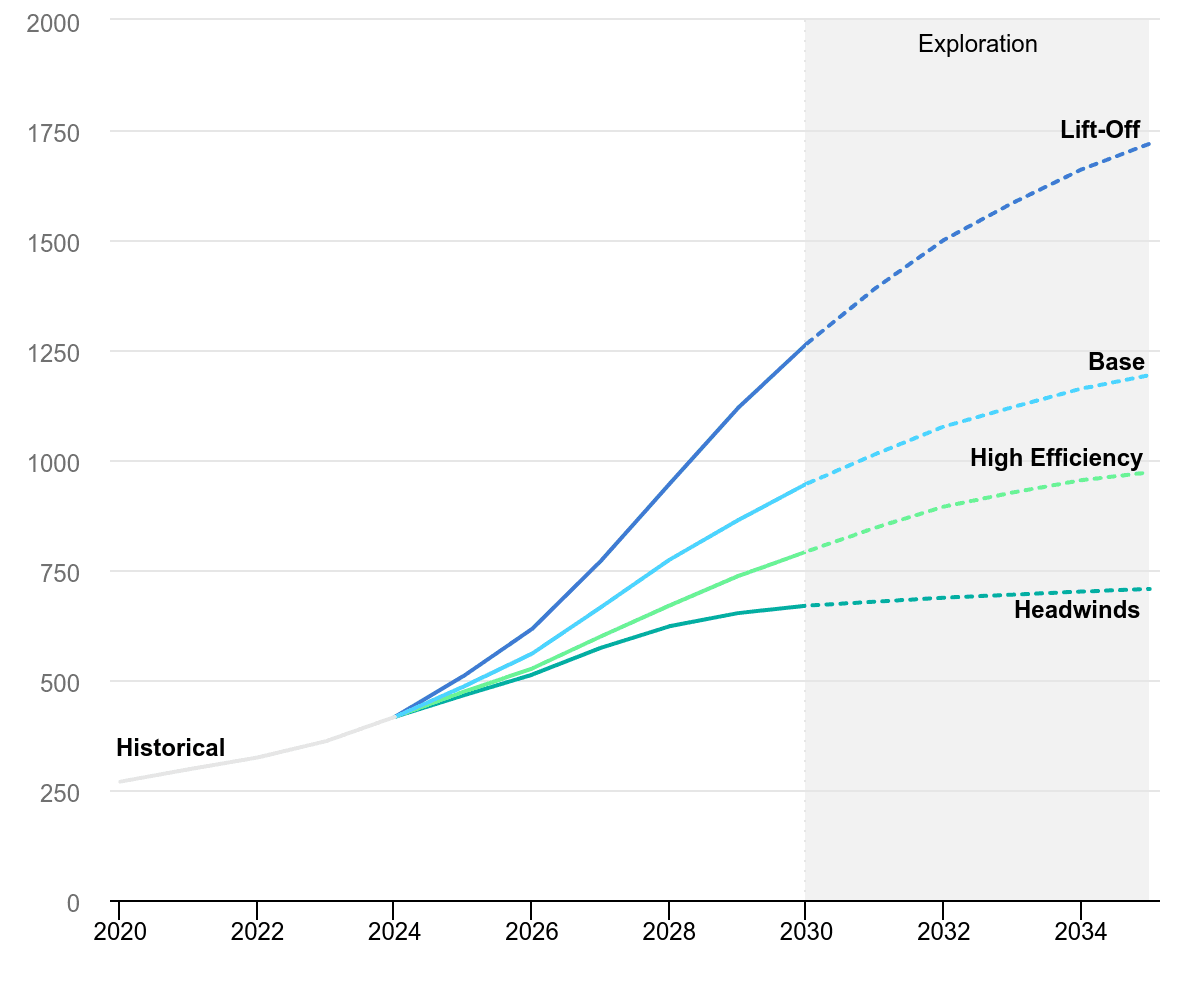
IEA (2025), Global data centre electricity consumption (TWh) by sensitivity case, 2020-2035, IEA, Paris, Licence: CC BY 4.0
IEA (2025), Global data centre electricity consumption (TWh) by sensitivity case, 2020-2035, IEA, Paris, Licence: CC BY 4.0
The diversion issue
Nevertheless, power demand from data centres is set to increase dramatically in the next decade, as indicated in this graph from the IEA (2025).
With the anticipated growth curve of AI being much steeper than the growth curve of energy, the immediate negative consequence is the diversion of energy infrastructure (clean power, transmission, transformers) required for AI, potentially slowing down the decarbonisation of other industries (Hiller & Ramkumar, 2024) and causing significant stress on energy grids. As Wilson, Fan, and Amanta (2025) recognise, "Problems with grid capacity and congestion have led to de facto moratoria on new data centres in The Netherlands, Singapore, and elsewhere."
Increases in power demand are expected to be met mostly with non-renewable energy. According to BloombergNEF, data centre demand could extend the life of existing coal and gas plants, with 64% of incremental power generation needed to meet data centre demand projected to be through fossil fuels.
Meanwhile, some investments originally designated for the development of clean energy are being diverted to fund AI projects instead (Ratcliffe & Paola, 2025).
The diversion issue
Nevertheless, power demand from data centres is set to increase dramatically in the next decade.
With the anticipated growth curve of AI being much steeper than the growth curve of energy, the immediate negative consequence is the diversion of energy infrastructure (clean power, transmission, transformers) required for AI, potentially slowing down the decarbonisation of other industries (Hiller & Ramkumar 2024).
Investments originally designated for the development of clean energy are also being diverted to fund AI projects instead (Ratcliffe & Paola 2025). At the same time, future increases in power demand might mostly be met with non-renewable energy — according to BloombergNEF, data centre demand could extend the life of existing coal and gas plants, with 64% of incremental power generation needed to meet data centre demand projected to be through fossil fuels.
The diversion issue
Nevertheless, power demand from data centres is set to increase dramatically in the next decade, as indicated in this graph from the IEA (2025).
With the anticipated growth curve of AI being much steeper than the growth curve of energy, the immediate negative consequence is the diversion of energy infrastructure (clean power, transmission, transformers) required for AI, potentially slowing down the decarbonisation of other industries (Hiller & Ramkumar, 2024) and causing significant stress on energy grids. As Wilson, Fan, and Amanta (2025) recognise, "Problems with grid capacity and congestion have led to de facto moratoria on new data centres in The Netherlands, Singapore, and elsewhere."
Increases in power demand are expected to be met mostly with non-renewable energy. According to BloombergNEF, data centre demand could extend the life of existing coal and gas plants, with 64% of incremental power generation needed to meet data centre demand projected to be through fossil fuels.
Meanwhile, some investments originally designated for the development of clean energy are being diverted to fund AI projects instead (Ratcliffe & Paola, 2025).
Local impacts
Simultaneously, the costs of infrastructure investment are being passed onto consumers, with consumer electricity bills rising notably in places where data centres are located — such as in the US states of Maryland, Virginia, and Oregon (Saul et al. 2025). This is drawing the ire of local residents, with officials increasingly feeling the pressure from their constituents. Utilities across the US are starting to make attempts to ensure that tech firms pay a fair share for the energy upgrades that their data centres require.
Water usage is another issue, as large AI models can consume millions of litres of freshwater for training. The problem is acute because water efficiencies vary spatially and temporally, and there are contamination risks associated with discharge, leading to pushback against building data centres near natural water sources (Li et al. 2025).
Local impacts
Meanwhile, the costs of infrastructure investment are being passed onto consumers, with consumer electricity bills rising notably in places where data centres are located – such as in the US states of Maryland, Virginia, and Oregon (Saul et al. 2025). This is drawing the ire of local residents, with officials increasingly feeling the pressure from their constituents. Utilities across the US are starting to make attempts to ensure that tech firms pay a fair share for the energy upgrades that their data centres require.
Water usage is another issue, as large AI models can consume millions of litres of water for training. The problem is acute because water efficiencies vary spatially and temporally, and there are contamination risks associated with discharge, leading to pushback against building data centres near natural water sources (Li et al. 2025).
Local impacts
Simultaneously, the costs of infrastructure investment are being passed onto consumers, with consumer electricity bills rising notably in places where data centres are located — such as in the US states of Maryland, Virginia, and Oregon (Saul et al. 2025). This is drawing the ire of local residents, with officials increasingly feeling the pressure from their constituents. Utilities across the US are starting to make attempts to ensure that tech firms pay a fair share for the energy upgrades that their data centres require.
Water usage is another issue, as large AI models can consume millions of litres of freshwater for training. The problem is acute because water efficiencies vary spatially and temporally, and there are contamination risks associated with discharge, leading to pushback against building data centres near natural water sources (Li et al. 2025).
The tech ecosystem
In spite of this, we currently witness a fragmentation of responsibility within the tech ecosystem, where investors, founders, big tech companies and energy experts operate in separate silos. There is a gap between those who are thinking about exponential technological curves and those who are concerned with physical energy system impacts and constraints. As such, sustainability is not yet seen as material enough at the earliest stages to significantly influence investment decisions.
The consensus is that change must be driven primarily by customers, particularly through enterprise procurement processes, acting as a critical 'signalling effect', which investors can then use to mobilise action.
Policy frameworks, such as the EU AI Act, are starting to mandate energy efficiency disclosure for models, which could provide initial transparency and allow customers to make comparisons between different providers (Hickman et al. 2025). Some efforts at standardising disclosures from industry figures have also taken shape: last year, Salesforce, working with Hugging Face, Cohere, and Carnegie Mellon University, released a benchmarking tool allowing developers to give their model a 1-5 ranking score. Salesforce said that it would disclose the energy efficiency data of its proprietary models under their new framework.
The tech ecosystem
In spite of this, we currently witness a fragmentation of responsibility within the tech ecosystem, where investors, founders, big tech companies and energy experts operate in separate silos. There is a gap between those who are thinking about exponential technological curves and those who are concerned with physical energy system impacts and constraints. As such, sustainability is not yet seen as material enough at the earliest stages to significantly influence investment decisions.
The consensus is that change must be driven primarily by customers, particularly through enterprise procurement processes, acting as a critical 'signalling effect', which investors can then use to mobilise action.
Policy frameworks, such as the EU AI Act, are starting to mandate energy efficiency disclosure for models, which could provide initial transparency and allow customers to make comparisons between different providers (Hickman et al. 2025). Some efforts at standardising disclosures from industry figures have also taken shape: last year, Salesforce, working with Hugging Face, Cohere, and Carnegie Mellon University, released a benchmarking tool allowing developers to give their model a 1-5 ranking score. Salesforce said that it would disclose the energy efficiency data of its proprietary models under their new framework.
The tech ecosystem
In spite of this, we currently witness a fragmentation of responsibility within the tech ecosystem, where investors, founders, big tech companies and energy experts operate in separate silos. There is a gap between those who are thinking about exponential technological curves and those who are concerned with physical energy system impacts and constraints. As such, sustainability is not yet seen as material enough at the earliest stages to significantly influence investment decisions.
The consensus is that change must be driven primarily by customers, particularly through enterprise procurement processes, acting as a critical 'signalling effect', which investors can then use to mobilise action.
Policy frameworks, such as the EU AI Act, are starting to mandate energy efficiency disclosure for models, which could provide initial transparency and allow customers to make comparisons between different providers (Hickman et al. 2025). Some efforts at standardising disclosures from industry figures have also taken shape: last year, Salesforce, working with Hugging Face, Cohere, and Carnegie Mellon University, released a benchmarking tool allowing developers to give their model a 1-5 ranking score. Salesforce said that it would disclose the energy efficiency data of its proprietary models under their new framework.
To tackle the uncertainty of these factors going forwards, we map out possible futures, indicating where the direction of travel may be in the hands of investors, asset managers and asset owners, and if not, what metrics can be monitored or mitigation strategies put in place.
So far, then, there remains much uncertainty about the scale of AI development, the rates of AI adoption, the levels and facets of AI regulation, and the feasibility of a greener AI stack or impactful AI applications.
To tackle this uncertainty, we map out possible futures, highlighting where the direction of travel may be in the hands of investors, asset managers and asset owners, and if not, what indicative metrics can be monitored or mitigation strategies put in place.
Load Growth Materialisation:
Continued focus on AGI-at-all-costs leads to an accelerated data centre build-out. As more and more investment is poured into AI, increasingly through private credit, tech leaders market and deploy AI more and more aggressively.
Geopolitical competition exacerbates this, with governments favouring larger models and more complex agentic structures over sustainable energy choices. There is little-to-no momentum generated for ‘greening’ the AI stack, and so data centre-driven energy demand increases unabated.
Consumer electricity bills skyrocket. In areas with data centres, discharge and contamination to potable water sources worsens. Drought frequency and intensity increases, and indicators of local water quality – such as temperature, pH, total dissolved solids, and conductivity – plummet. Sociopolitical backlash is fomented.
Prominence of critical media coverage of data centre buildout and AI deployment grows, and sentiment analysis shows headlines to be increasingly negative. Legislative and regulatory activity aimed at restricting data centre development and AI use ramps up, but ultimately fails to materialise into law.
Lack of climate-beneficial applications:
AI’s potential for disruption in frontier climate innovation is underfunded and fails to deliver at scale, with innovations and efficiency improvements becoming more prevalent in oil and gas prospecting than in climate improvements. In the near to mid term, global CO2 emissions increase more than previously anticipated, with fossil fuels brought onto the grid to meet short-term demand for electricity generation for data centres.
Global temperature averages rise, greenhouse gases concentrate, extreme weather events occur with increasing frequency and intensity. Profound societal and economic impact is inflicted as food security levels decrease and populations are displaced.

Here, we diverge into two sub-scenarios based on AI adoption rates:
Future I: Worst-case scenario
Our worst-case scenario is driven by two main factors:
Scenario A: AI capabilities continue to expand and AI is deployed in the economy widely:
AI adoption becomes widespread, due to three key factors (Wilson, Fan, Amanta 2025):
AI developers manage to realise AI use cases with material value at scale, across business and consumer sectors.
They have prioritised trust in their systems, putting enterprises and consumers at ease and enabling such scale.
They have made some improvements in the energy efficiency of both AI models and data centres, overcoming previous energy bottlenecks.
However, any improvements in energy optimisation and efficiency enabled by AI – both in the deployment of AI itself, but also across the energy sector more broadly – have been negated by the dramatic increase in overall AI consumption. These 'rebound effects' continue to worsen the climate problem.
Meanwhile, widespread deployment of AI has led to mass job loss and displacement. Inequality is sent skyrocketing, increasing social polarisation to an unprecedented level.
This weakens social consensus, the democratic institutions required for strong climate governance, and the political importance of climate, undermining much of the political progress on climate made to date (Amanta & Wilson 2025).
It becomes obvious that there has been an overbuilding of data centres. Many that have been built sit at low utilisation rates, and it’s not clear that they can be repurposed. Ongoing building projects are halted. Major investments are wasted and unneeded fuel infrastructure becomes stranded, despite the significant resources spent in its development which had been diverted from renewables (Lovins 2025).
Technology company valuations, including hyperscalers, specialised AI firms, and chip manufacturers undergo drastic corrections overnight, which reverberates across the global economy and inflicts major capital losses. Private credit vehicles, which have been relied upon to finance much of the data centre infrastructure, are forced to take persistent and often devastating net asset value write-downs.
The economic fallout affects not just tech and AI-related roles, but also construction and manufacturing sectors. Inequality and populism is on the rise, and public and political discourse becomes dominated by the economic crisis, pushing climate change down the list of priorities. The erosion of capital in VC, PE and also in public finances dramatically reduces the appetite for funding climate change solutions.
Scenario B: AI adoption is much lower than expected:
Developers have failed to overcome the key challenges of developing AI use cases with realisable value, bottlenecks in energy supply, and trustworthiness. As a result, AI adoption falters.
The general public, in failing to trust AI systems, particularly with their personal data, do not adopt consumer-facing climate-beneficial applications at scale (Vrain and Wilson, 2025).

Load Growth Materialisation:
Continued focus on AGI-at-all-costs leads to an accelerated data centre build-out. As more and more investment is poured into AI, increasingly through private credit, tech leaders market and deploy AI more and more aggressively.
Geopolitical competition exacerbates this, with governments favouring larger models and more complex agentic structures over sustainable energy choices. There is little-to-no momentum generated for ‘greening’ the AI stack, and so data centre-driven energy demand increases unabated.
Consumer electricity bills skyrocket. In areas with data centres, discharge and contamination to potable water sources worsens. Drought frequency and intensity increases, and indicators of local water quality – such as temperature, pH, total dissolved solids, and conductivity – plummet. Sociopolitical backlash is fomented.
Prominence of critical media coverage of data centre buildout and AI deployment grows, and sentiment analysis shows headlines to be increasingly negative. Legislative and regulatory activity aimed at restricting data centre development and AI use ramps up, but ultimately fails to materialise into law.
Lack of climate-beneficial applications:
AI’s potential for disruption in frontier climate innovation is underfunded and fails to deliver at scale, with innovations and efficiency improvements becoming more prevalent in oil and gas prospecting than in climate improvements. In the near to mid term, global CO2 emissions increase more than previously anticipated, with fossil fuels brought onto the grid to meet short-term demand for electricity generation for data centres.
Global temperature averages rise, greenhouse gases concentrate, extreme weather events occur with increasing frequency and intensity. Profound societal and economic impact is inflicted as food security levels decrease and populations are displaced.
Here, we diverge into two sub-scenarios based on AI adoption rates:
Future I: Worst-case scenario
Our worst-case scenario is driven by two main factors:
Scenario A: AI capabilities continue to expand and AI is deployed in the economy widely:
AI adoption becomes widespread, due to three key factors (Wilson, Fan, Amanta 2025):
AI developers manage to realise AI use cases with material value at scale, across business and consumer sectors.
They have prioritised trust in their systems, putting enterprises and consumers at ease and enabling such scale.
They have made some improvements in the energy efficiency of both AI models and data centres, overcoming previous energy bottlenecks.
However, any improvements in energy optimisation and efficiency enabled by AI – both in the deployment of AI itself, but also across the energy sector more broadly – have been negated by the dramatic increase in overall AI consumption. These 'rebound effects' continue to worsen the climate problem.
Meanwhile, widespread deployment of AI has led to mass job loss and displacement. Inequality is sent skyrocketing, increasing social polarisation to an unprecedented level.
This weakens social consensus, the democratic institutions required for strong climate governance, and the political importance of climate, undermining much of the political progress on climate made to date (Amanta & Wilson 2025).
It becomes obvious that there has been an overbuilding of data centres. Many that have been built sit at low utilisation rates, and it’s not clear that they can be repurposed. Ongoing building projects are halted. Major investments are wasted and unneeded fuel infrastructure becomes stranded, despite the significant resources spent in its development which had been diverted from renewables (Lovins 2025).
Technology company valuations, including hyperscalers, specialised AI firms, and chip manufacturers undergo drastic corrections overnight, which reverberates across the global economy and inflicts major capital losses. Private credit vehicles, which have been relied upon to finance much of the data centre infrastructure, are forced to take persistent and often devastating net asset value write-downs.
The economic fallout affects not just tech and AI-related roles, but also construction and manufacturing sectors. Inequality and populism is on the rise, and public and political discourse becomes dominated by the economic crisis, pushing climate change down the list of priorities. The erosion of capital in VC, PE and also in public finances dramatically reduces the appetite for funding climate change solutions.
Scenario B: AI adoption is much lower than expected:
Developers have failed to overcome the key challenges of developing AI use cases with realisable value, bottlenecks in energy supply, and trustworthiness. As a result, AI adoption falters.
The general public, in failing to trust AI systems, particularly with their personal data, do not adopt consumer-facing climate-beneficial applications at scale (Vrain and Wilson, 2025).
Future II: Best-case scenario
Push towards efficiency
The largest energy and water-intensive AI models face growing regulatory scrutiny, reputational risk, and procurement barriers, especially in B2B markets where enterprise customers increasingly look to reduce compute costs and require sustainability metrics.
As a result, asset owners begin to actively put pressure on investors by asking specific, at times non-negotiable, questions about environmental governance. In turn, VC investors increasingly push founders to adopt a ‘full system approach’ early-on and throughout the development phase: considering safety, environmental impact, and energy mix when making build decisions.
This involves asking founders to think about the trade-offs they are making between energy use and model performance, to measure and estimate the energy footprint of their AI systems, and to benchmark their models’ energy performance against alternatives.

As startups grow, they are pushed to systematically monitor their energy use across training and inference using established tools, make these metrics available for stakeholders, and actively optimise their processes with a view to cutting energy consumption.
At the same time, asset owners increasingly invest in ways to make AI models more energy and water-efficient, such as in clean energy-powered data centres and in solutions that reuse waste heat. Not only does the deployment of AI itself become more climate-positive, the momentum to develop climate-positive AI use-cases grows. Using asset owner capital, asset owners create dedicated funds and allocations to shift VC incentives and de-risk investments in climate-positive AI use-cases; balancing internal risks (real asset exposure to climate change) with climate technology investment.
Opportunities in AI applications
With a new and reinforced mandate to invest in climate-positive AI applications, VCs help ensure that the pivotal role of AI in achieving net-zero goals is realised. Startups working to accelerate innovation in this space attract high valuations, with the result that AI accelerates discovery processes for catalysts, new materials, and battery chemistries (Wilson, Fan, Amanta 2025).
Applications become focused on improving energy outcomes in high-impact sectors like power, buildings, transport, and industry. Small, specialised models are developed for applications that require high-quality, localised or proprietary data, like in pharmaceuticals, finance, or agricultural measurement. These models align with sustainability and data protection guidelines.
The ability of AI to search and translate between different languages unifies massive volumes of fractured research across science and policy research. This accelerates scientific research and development with widespread systemic benefits to our ability to model complex futures and make effective policy.
Future II: Best-case scenario
Push towards efficiency
The largest energy and water-intensive AI models face growing regulatory scrutiny, reputational risk, and procurement barriers, especially in B2B markets where enterprise customers increasingly look to reduce compute costs and require sustainability metrics.
As a result, asset owners begin to actively put pressure on investors by asking specific, at times non-negotiable, questions about environmental governance. In turn, VC investors increasingly push founders to adopt a ‘full system approach’ early-on and throughout the development phase: considering safety, environmental impact, and energy mix when making build decisions.
This involves asking founders to think about the trade-offs they are making between energy use and model performance, to measure and estimate the energy footprint of their AI systems, and to benchmark their models’ energy performance against alternatives.
As startups grow, they are pushed to systematically monitor their energy use across training and inference using established tools, make these metrics available for stakeholders, and actively optimise their processes with a view to cutting energy consumption.
At the same time, asset owners increasingly invest in ways to make AI models more energy and water-efficient, such as in clean energy-powered data centres and in solutions that reuse waste heat. Not only does the deployment of AI itself become more climate-positive, the momentum to develop climate-positive AI use-cases grows. Using asset owner capital, asset owners create dedicated funds and allocations to shift VC incentives and de-risk investments in climate-positive AI use-cases; balancing internal risks (real asset exposure to climate change) with climate technology investment.
Opportunities in AI applications
With a new and reinforced mandate to invest in climate-positive AI applications, VCs help ensure that the pivotal role of AI in achieving net-zero goals is realised. Startups working to accelerate innovation in this space attract high valuations, with the result that AI accelerates discovery processes for catalysts, new materials, and battery chemistries.
Applications become focused on improving energy outcomes in high-impact sectors like power, buildings, transport, and industry. Small, specialised models are developed for applications that require high-quality, localised or proprietary data, like in pharmaceuticals, finance, or agricultural measurement. These models align with sustainability and data protection guidelines.
The ability of AI to search and translate between different languages unifies massive volumes of fractured research across science and policy research. This accelerates scientific research and development with widespread systemic benefits to our ability to model complex futures and make effective policy.
Takeaways for Investors
Takeaways for Investors
Takeaways for Investors
The future direction of AI's impact on the climate is not inevitable. The decision tree remains broad and at many critical points, is shaped by the decisions of innovators and capital allocators.
The future direction of AI's impact on the climate is not inevitable. The decision tree remains broad and at many critical points, is shaped by the decisions of innovators and capital allocators.
There are opportunities which exist in the ‘greening’ of the AI stack, but they are currently underfunded:
Reducing the cost of AI: Software optimisations exist to reduce energy-use of AI applications, with substantial cost savings with little impact on AI capabilities (Frugal AI Hub, 2026). Small language models (SLMs) are an alternative which require less compute to train and use, and are showing impressive capability levels, particularly in well-designed architectures. SLMs offer co-benefits beyond energy efficiency, such as better privacy protection, reduced bias, and relevance in data-scarce emerging markets (Belcak et al. 2025, Nanni et al. 2025).
More efficient grid management, which AI itself can help with (IEA 2025). By handling complex electricity networks and intermittent renewables, data centres can come online faster and operate flexibly. More dynamic scheduling of when and where (i.e. which data centre) AI training occurs, based on real-time local weather conditions, can also make inference much more water-efficient (Li et al. 2025).
Greener data centres: Not only can data centres be more flexible, they can also be powered with cleaner energy and fuel sources. Heat generated by IT equipment can also be reused – for example, for district heating. Reusing waste heat reduces greenhouse gas emissions in the neighbourhood by removing the need for fossil-fuel powered heating (WEF 2025).

There are also opportunities in the application of AI technology to the climate challenge, which would cut emissions in a variety of sectors (IEA 2025, Stern et al. 2025):
Optimising manufacturing processes, such as improving the fuel mix for cement production
More efficient vehicle operations, such as better route selection and improving adoption rates of EVs
Optimising heating, ventilation and air conditioning control in building complexes.
Enhancing detection of leaks that contribute to methane emissions in oil and gas operations
Enhancing stability and efficiency of renewable energy integration into power grids
Improving adoption rates of meat alternatives by identifying proteins with suitable properties
Practical actions you can take:
Collect and monitor data on energy consumption, water usage, and carbon intensity across your AI portfolio, benchmarking against industry standards.
Push founders to adopt a 'full system approach' from the earliest stages: considering energy mix, water impact, and environmental trade-offs alongside model performance when making build decisions.
Assess the climate resilience of data centre infrastructure within your portfolio (e.g., exposure to heat stress, water scarcity, and extreme weather events).
Encourage and fund the development of right-sized machine learning models. Small language models can deliver strong performance at a fraction of the energy cost, with co-benefits for privacy and bias reduction. Platforms such as Hugging Face's HuggingChat offer a practical environment for testing.
Monitor public sentiment and media coverage around data centre buildout in key regions, as sociopolitical backlash can translate into regulatory risk and reputational exposure.
Understand and strategise at an organisational level the aptitude for contributing to this systemic risk.
Feedback on this scenario

Reframe Venture Ltd. Company Number: 13492915.
Registered Office: Churchill House, 137-139 Brent Street, London, England, NW4 4DJ
Get in touch: hello@reframeventure.com
Reframe Venture Ltd. Company Number: 13492915.
Registered Office: Churchill House, 137-139 Brent Street, London, England, NW4 4DJ
Get in touch: hello@reframeventure.com
Reframe Venture Ltd. Company Number: 13492915.
Registered Office: Churchill House, 137-139 Brent Street, London, England, NW4 4DJ
Get in touch: hello@reframeventure.com